
GoBFree New Transit Technology for Orlando
While GoBFree Robotaxi’s private chauffeur experience will change commuting around the world, transporting tourists and residents in the Orlando area is a special situation for a first market. Autonomous vehicles drive around the Orlando airport, amusement parks (Disney World, Universal Epic, Sea World, and others), convention center, and dozens of hotel complexes, then connect to an elevated rail system that carries them above congestion. The elevated rail, compared to Elon Musk’s Boring tunnels, has many advantages: lower construction costs, greater flexibility, automatic battery charging, reduced weather delays, level-5 self-driving, 100+ mph, a better consumer experience than a tunnel, and higher throughput. Realizing Walt Disney’s vision of the future is a great inspiration.
Comparative Performance
Cost
Under 2 cents per mile operational cost
Environment
90% reduction in transportation air pollution.
Resilience
Operates at full speed during heavy weather.
Background
Moving an estimated 80,000 people a day between Orlando Airport and the Brightline train station to Disney World, Universal Orlando, SeaWorld, the Convention Center, and dozens of large hotel complexes causes significant delays. This is a problem not only for amusement park visitors but also for the entire region, which faces some of the worst congestion in the US. With significant future population growth in Orlando and the expansion of amusement parks, it is going to get much worse.
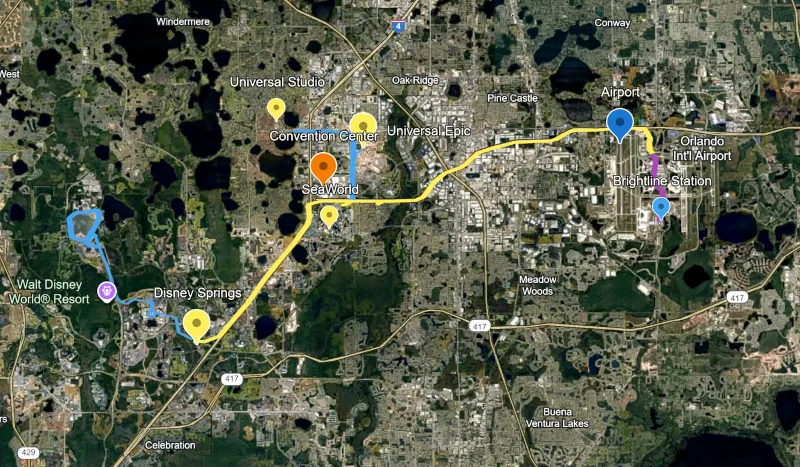
At much lower cost and with far greater convenience, we can transport them using the GoBFree technology. Private autonomous four-passenger Robotaxis waiting at the curb of the airport, Brightline arrival area, Convention Center, or front door of the hotels, drive a short distance to an 18-mile-long, flat, elevated rail system going from the airport, past Universal Orlando and the Convention Center to Disney World (see map below). While this is a revolutionary idea, much of the technology is tested hundreds of times each day in Orlando by the world’s top roller-coaster engineers.
Autonomous cars, freight, and taxis are changing our world. Companies like Zoox (SF and Las Vegas, Amazon), Waymo (Google), Tesla Cybercab, Holon (Jacksonville), May Mobility (Ann Arbor), WeRide (China, Southeast Asia, Nvidia, Uber), AuveTech/Guident Systems (West Palm Beach), Beep (Orlando), Glydway (SF and Atlanta, Sam Altman), and others are perfecting driverless vehicle technology that we will use. They do not solve congestion(probably makes it worse), have problems at high speeds, misinterpret unusual situations, require battery charging, and are expensive.
Our small group of engineers, marketing professionals, and others is joined by two organizations recognized worldwide for their expertise in roller coasters and amusement parks: Tampa-based Premier Rides and Cincinnati-based International Theme Park Services. Our expertise in this field is based on years of real-world work with our proof-of-concept vehicles, consultations with roller coaster companies, and numerous studies, including a year-long, multidisciplinary research effort by Texas A&M University.
Our timing is good. Currently, the Orlando City and Orange County governments are being proactive, seeking solutions to move people from the airport and the Brightline rail depot to tourist destinations. With so many destinations and a limited schedule, rail is less effective than on-demand, private GoBFree RoboTaxi. Wait times, last-mile problems, 24-hour availability, security concerns, and severe congestion throughout the area caused by frequent rail crossing closures are just a few of the issues. GoBFree is a 24/7 door-to-door service that will reduce congestion for everyone.
Elon Musk’s Boring Company and Universal Orlando are considering the construction of an underground tunnel between Universal Studios and Epic Universe. Given Florida’s notorious sinkholes and swampy conditions, this presents a challenging engineering project. In contrast, the GoBFree elevated track is more cost-effective and adaptable than tunnels. It enables automatic battery charging, is completely self-driving, is less affected by weather, has a higher capacity (four tracks versus two tunnels), and offers a superior consumer experience, providing elevated views rather than an underground tunnel. GoBFree is a solution for the entire region, not just for several miles.
More information on the GoBFree technology is at GoBFree.com. There is also an interesting YouTube video that discusses the Orlando congestion and the rail project, “Why isn’t there public transit between the Airport and Disney World?”.
Details
Passengers arriving at Orlando Airport (156,000 daily passengers, roughly half going to the resorts, convention center, and other nearby stops) and the Brightline train station (8,000 daily arrivals) would exit the baggage claim area and get into a waiting private GoBFree four-passenger driverless vehicle, developed in conjunction with one of the existing autonomous low-speed neighborhood vehicles (BEEP, Zoox, Glydwa, and others). No wait, no phone call, and no unpredictable driver. The GoBFree Robotaxi would proceed north about ½ mile from the arrival area to the rail, where it clips onto an overhead electric sled mounted on the elevated rail. It then travels non-stop 12 to 18 miles at 100+ mph to the main tourist areas, including Disney World with four distinct resorts (134,000 daily), Universal Orlando with three resorts, and its new Epic Universe (75,000 daily), SeaWorld (11,000 daily), 35 hotels near or in the resorts, or the Convention Center (5,000 daily). While on the rails with full self-driving, the batteries recharge, and GoBFree travels above some of the worst traffic in the United States, especially near the resorts. When the GoBFree approaches the destination, it disconnects from the rail and continues on local roads.
The charge for this service would range from $40 to $50 per vehicle, comparable to Uber and Lyft ($35 to $50) and less than taxis ($45 to $90). There is a bus service between the airport and Disney World that costs $18 per person but requires a longer wait and many stops.
The proposed track route is shown on the attached map. It runs along the south side of State Route 528 and the west side of Interstate 4 (it could also run through a utility easement east of Interstate 4). Because many of the roadways in the area include wide drainage ditches and undeveloped marshes, there is sufficient right-of-way.
Why Orlando First ...
It is a relatively easy environment for the technology because, when the vehicles are disconnected from the rail at the airport and in resort areas, they drive at low speeds and in highly controlled surroundings, unlike in busy, unpredictable downtown LA, Austin, SF, NYC, and other markets. The self-driving vehicles being tested by Tesla, Waymo, Zoox, and others struggle in high-speed, unfamiliar situations but could easily handle 25 mph road travel in geofenced areas.
In the 1960’s, Walt Disney’s vision for his Orlando park was to create a futuristic city inspired by his exhibits at the NYC World’s Fair in 1964. Although his futuristic world was never fully realized, Epcot (Experimental Prototype Community of Tomorrow) became an important part of Disney’s legacy. Working with Orlando, Disney, and other officials, we can achieve that vision and inspire a worldwide future of sustainable transportation.
GoBfree extends the Disney/Universal/fantasy to arriving passengers. Instead of waiting for a bus or train, walking to pick-up spots or car rentals, and fighting traffic, customers enjoy a high-tech ride. Because each vehicle is private, passengers could complete the registration process and enjoy presentations specific to their visit.
There is a captive consumer, paying a healthy price like most airport transportation systems, who needs to get from the airport to the amusement parks. Plus, we deliver visitors faster and with no congestion.
The track is only 18 miles long, versus other markets that require a 50-mile track. We need about 12,000 trips provided by 1,500 vehicles per day to break even. Approximately 14,000 people take the bus from the airport to Disney each day. Uber, Lyft, and rental cars carry another 64,000 per day. Assuming 12,000 trips with 2.4 riders per vehicle (the average size of a tourist group to Orlando), we should be able to capture 29,000 of the approximately 78,000 passengers traveling from the airport to the resorts, convention center, and nearby destinations.

Validated by the Texas Transportation Institute
Independent feasibility and performance analysis completed.
The Seamless Journey
Experience true point-to-point travel without the friction of traditional mass transit.

Phase 1: Local Control
Begin your journey exactly like you do today. Drive your compatible vehicle manually on local streets from your driveway to the nearest GoBFree network ramp.
Phase 2
Begin your journey exactly like you do today. Drive your compatible vehicle manually on local streets from your driveway to the nearest GoBFree network ramp.
Phase 3
Begin your journey exactly like you do today. Drive your compatible vehicle manually on local streets from your driveway to the nearest GoBFree network ramp.
Frequently Asked Questions
Understanding the mechanics and vision behind the next era of mobility.
How safe is the GoBFree autonomous system?
Safety is our foundational engineering principle. The GoBFree system utilizes redundant Level 5 autonomous sensors, dedicated grade-separated infrastructure (meaning no intersections or pedestrian conflicts), and a centralized traffic management system. This eliminates human error, which is responsible for 94% of traditional traffic accidents.
What happens in bad weather like heavy rain or snow?
Safety is our foundational engineering principle. The GoBFree system utilizes redundant Level 5 autonomous sensors, dedicated grade-separated infrastructure (meaning no intersections or pedestrian conflicts), and a centralized traffic management system. This eliminates human error, which is responsible for 94% of traditional traffic accidents.
Is it really more cost-effective than public transit?
Safety is our foundational engineering principle. The GoBFree system utilizes redundant Level 5 autonomous sensors, dedicated grade-separated infrastructure (meaning no intersections or pedestrian conflicts), and a centralized traffic management system. This eliminates human error, which is responsible for 94% of traditional traffic accidents.
Can my current electric vehicle be retrofitted?
Safety is our foundational engineering principle. The GoBFree system utilizes redundant Level 5 autonomous sensors, dedicated grade-separated infrastructure (meaning no intersections or pedestrian conflicts), and a centralized traffic management system. This eliminates human error, which is responsible for 94% of traditional traffic accidents.
Ready to fly above the traffic?
We are currently engaging with strategic investors and municipal partners who believe the future of transportation extends beyond traditional roads to scale this infrastructure globally.